
Clark County Court Record Requests
Which Clark County office holds the record depends on the case type. For Common Pleas, search CourtView for docket information. Then turn to the Clerk Civil, Criminal, or Domestic channel for papers, judgments, or certified items. Municipal dockets run through Municipal Case Search. The Municipal clerk or case division handles record help. Probate keeps its own Record Search, a historical-research page, and a counter. Juvenile records, along with sealed or restricted material, must follow that court's access rules.
Give the clerk specifics. Name the court and the case number if you have it. Add the party names, the rough year, and whether you want a docket, a named document, a plain copy, or a certified copy. Common Pleas local rules let you examine a file in person during regular hours. They bar anyone from removing records from clerk custody. Copies are allowed on request once you pay the photocopy fee. One caution: the county public-records directory sends court-record requests to the court offices themselves. There is no single universal legal-record request form.
- Identify the owning court and record type before submitting a request.
- Use that court’s official search route to confirm a case number and date range when possible.
- Tell the clerk exactly which document or docket information is needed and whether certification is required.
- Ask the court to confirm its current fee, payment method, delivery method, and any access limitation.
- Use the court counter, phone, or written route when a web record is missing, old, restricted, or not certified.
Clark County Docket and Case File Difference
Three record types get mixed up all the time. An appearance docket is the clerk's chronological index. It covers filings, process, settings, continuances, decisions, and final entries. A filed document or case file is the actual paper underneath. That might be a complaint, motion, return, order, judgment, or exhibit that a docket entry may point to. A certified copy is different again. That is the clerk's official product, made when some particular use requires certification.
| Record type | What it does | Clark County access point |
|---|---|---|
| Docket or appearance docket | Lists dated case activity. | Official court portal or clerk channel. |
| Filed document | The underlying pleading, order, or judgment. | Owning clerk, with remote access limits. |
| Certified copy | Clerk-issued official copy in the requested form. | Request from the clerk that maintains the case. |
A web docket is not automatically certified, and it does not guarantee that every document image is online. So a docket search may find the order you want while the clerk still has to supply the copy itself.
Kinds of Court Records
The Common Pleas Clerk of Courts maintains felony criminal, general civil, adult domestic-relations, and county appellate filings. Municipal records cover traffic, misdemeanor criminal, parking, trusteeship, TPO, small claims, eviction, and other qualifying civil matters. Probate holds estates, guardianships, adoption, marriage, name changes, mental illness, trusts, and related proceedings. Juvenile cases run through a separate court route.
Availability online varies. CourtView shows docket entries the law requires, subject to exceptions. Municipal public search sits apart, and Probate posts records on its own system. Ask the court that owns the case for copies. That matters when a case moved from Municipal preliminary proceedings to Common Pleas, or from a Mayor's Court into Municipal Court on appeal.
Clark County Direct File Inspection
Common Pleas local rules create one concrete access channel. During regular business hours, you may examine a case file or original document held in the clerk's custody. Records cannot leave the building. You can request copies by paying the photocopy fee. The clerk tries to respond within 24 hours, depending on how large the request is. Note the limit, though. This is a local rule for clerk-held access, not a promise that staff will run an unrestricted search for you.
Clark County Clerk Legal Division
101 North Limestone Street, second floor
Springfield, OH 45502
937-521-1680
Monday through Friday, 8:00 a.m. to 4:30 p.m. Direct lines: Civil 937-521-1697, Criminal 937-521-1684, Domestic 937-521-1693, and Appeals 937-521-1683.
Ask the clerk to point your request at the right division. Domestic Relations is listed separately at 31 North Limestone Street, lower level, so confirming the proper counter before you travel saves a wasted trip.
Court Records: What They Contain
Clark County Common Pleas rules spell out what an appearance docket records. The list includes the assigned judge, the caption or nature of the case, the annual serial number, the case type, pretrial and trial settings, continuances, the decision or verdict, and the final entry. Ohio law also backs recording party and counsel names. Process issued, papers filed, returns, and filing dates are covered too. Treat these as court-record categories. No public portal is guaranteed to display every field the same way.
| Caption and case number | Identifies the case and the court’s record. |
|---|---|
| Filing chronology | Dated papers filed, process, and returns where the appearance docket records them. |
| Settings and continuances | Scheduled pretrial or trial activity and later moved dates. |
| Decision or judgment | The court action and its final entry where applicable. |
| Restricted material | Personal identifiers and documents excluded or limited by statute, rule, or order. |
Older Clark County Case File Access
Common Pleas online information stops short of records before 1990. Municipal Court says its computerized records begin January 1, 1990. Those cutoffs do not mean older case files were destroyed. They mean the route is the court counter or clerk, and you should bring the court, the year, the names, and the item you need. Probate offers the clearest historical map of all: estate records from 1818 through 1985 sit on Probate microfilm, with the originals held at the Clark County Historical Society.
The Probate historical-research page documents that route and its copy information. 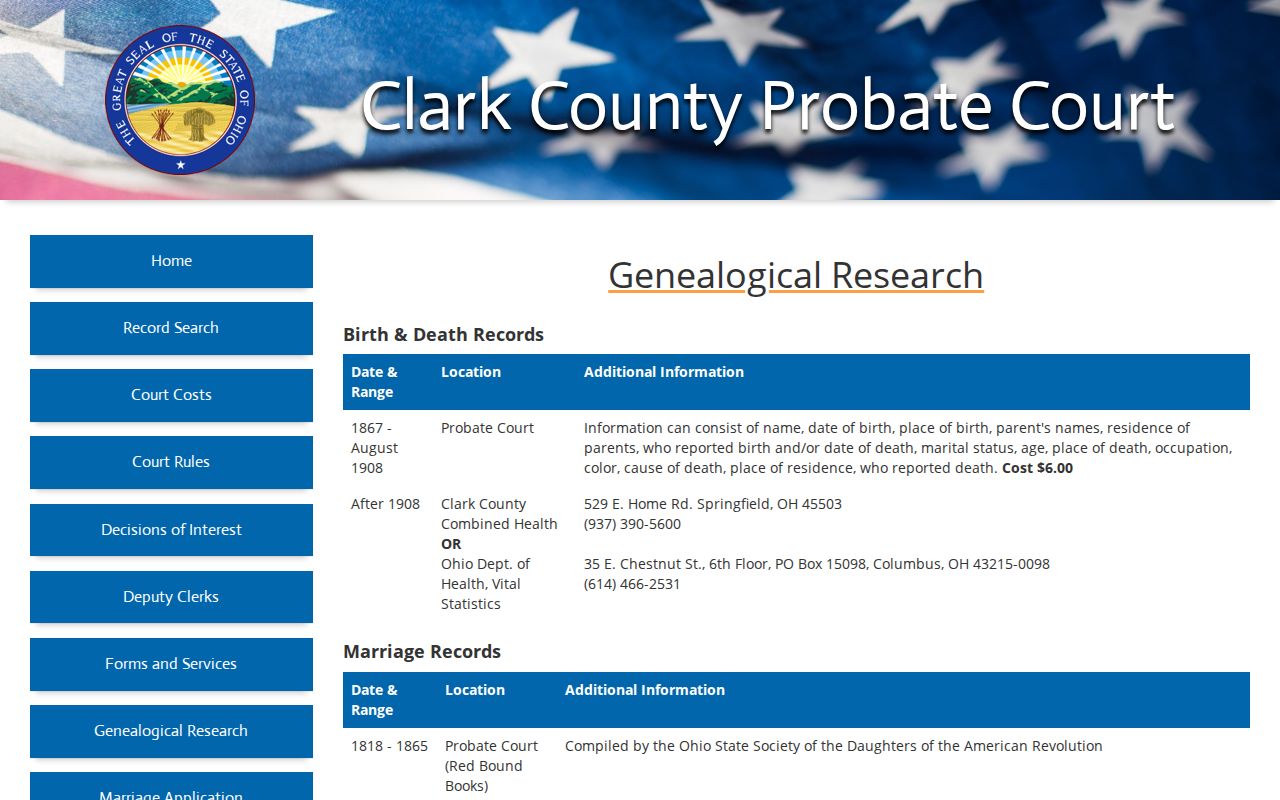 Probate says records from 1985 forward are in microfilm or scanned images, while divorce records through 1990 are routed to the courthouse and later divorce records to the Common Pleas Clerk.
Copy Fees and Certification
Clark County sets no single court-copy price, so ask the office you are dealing with. Common Pleas lists domestic certification at $1 per page. It also charges a $5 certificate-of-judgment making fee and separate filing deposits. Those figures are not a generic certification schedule for every court. Municipal posts no generic copy or certification fee. Probate gives specific estate and marriage copy amounts.
| Office or item | Official amount | Scope |
|---|---|---|
| Common Pleas domestic certification | $1 per page | Published as a domestic certification item. |
| Common Pleas certificate of judgment, making | $5 | Not a generic copy fee. |
| Probate estate copies | $0.25 per page plus $3 for closed files | Probate historical-research category. |
| Probate marriage certified record before 1991 | $5 first copy, $2 additional | Marriage category only. |
| Municipal generic copies | Fee not located | Ask the clerk before payment. |
Before ordering, confirm the current cost, the payment method, and whether a plain, certified, or exemplified form is available. A filing-cost PDF is no substitute for a record-copy quote.
Clark County Probate Copy Route
Probate runs its own shop in Clark County. The Probate judge doubles as the clerk. Deputy clerks can certify records and take filings for that court docket. To reach them, go to the fifth floor at 50 East Columbia Street in Springfield. You can also call 937-521-1845. The court documents its own access channels. These include the Record Search, service forms, phone and email contacts, the counter route, and its guidance for historical research.
Digging for an old estate file? Identify the record range first, then follow the court's own microfilm and archive guidance. Keep one thing clear about case lookup results here. A hit on a search is not a certified or verified record. Adoption and mental-health case records are restricted. Ask Probate directly about the current procedure for the record type you need.
Clark County and Federal Record Split
A federal case with ties to Clark County does not sit with the Clark County Clerk. Federal civil and criminal filings live in a separate system. You search them through PACER and CM/ECF. That system is run by the U.S. District Court for the Southern District of Ohio, Western Division at Dayton. That office shares nothing with the county courts. PACER is the official federal docket source. It covers federal matters only. It will never stand in for a county court record. Common Pleas, Municipal, and Probate records stay with the county.
The official PACER fee page explains its access charges and quarterly waiver rule.  Keep the court system separate before requesting a copy, because each clerk is the custodian for its own case record.
Access Rules for Court Records
Ohio's public-access rules start from a presumption that court records are open, but they split access into two kinds: direct access and remote electronic access. Two statutes matter here. Ohio R.C. 2303.12 covers the Common Pleas general docket. R.C. 2303.901 defines what counts as a case document while allowing exclusions for personal identifiers and restricted material. Ohio's public-records law is useful background. Court case access, though, is governed mainly by the courts' own public-access rules, not by the request process used for executive agencies.
Key access authorities:
Ohio public-access rules set the access presumption and restrictions framework.
Ohio R.C. 2303.12 describes Common Pleas docket and case-file duties.
Ohio R.C. 149.43 is the state public-records statute.
The Ohio public-records statute is useful context. 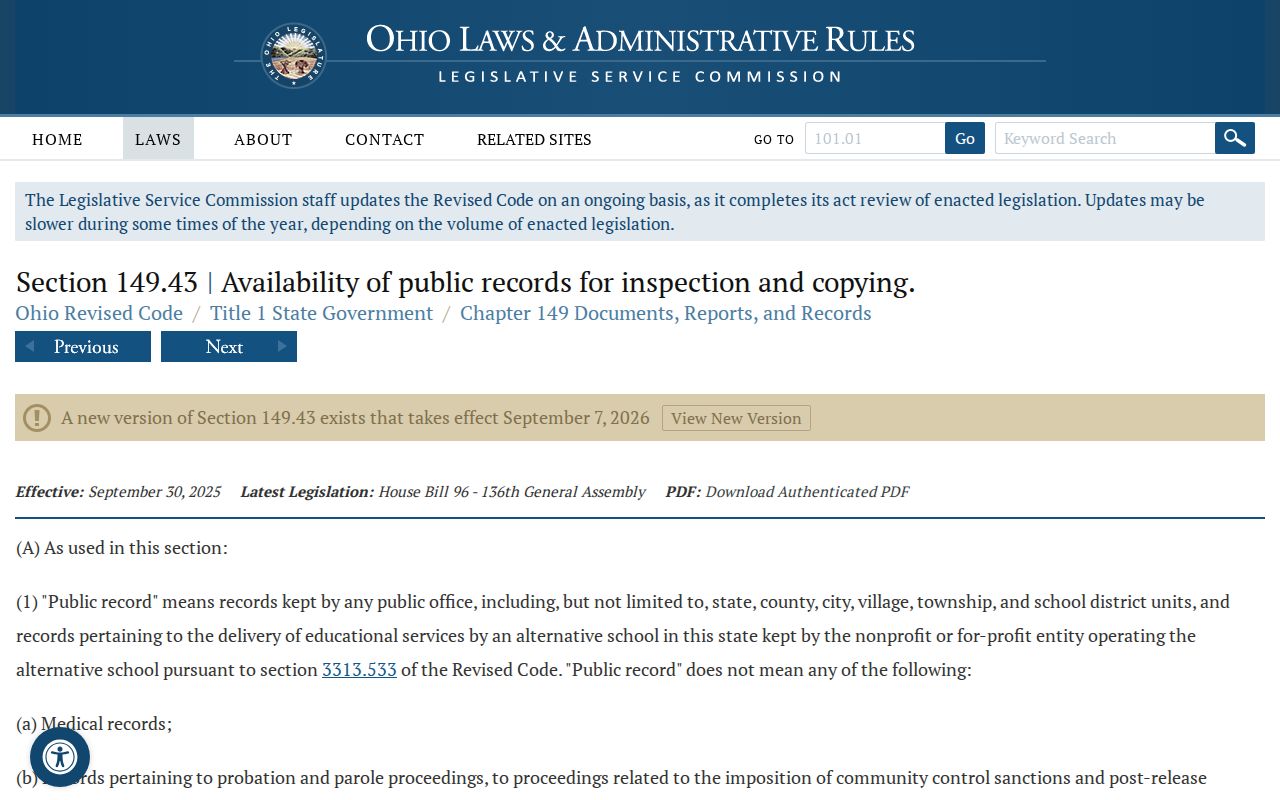 Sealed records, juvenile records, personal identifiers, adoption or mental-health materials, and court-restricted documents remain subject to the owning court’s rules.